You Gotta Have Art: How Coachella’s 2026 Program Continues to Inspire
Author:Jessica RitzEverything you hear about Coachella is true. The brands and influencers running amok among the masses, along with memorable sets by headlining and emerging musical artists that have driven the festival’s raison d’être since its launch in 1999, continue to lure crowds back to Indio, California. Over the past decade, another zeitgeist-attuned component has emerged from the layout that rises on the Empire Polo Club grounds every April like a madcap, music-obsessed, present-day world’s fair.
The dynamic, interactive art installations have become a more significant part of the experience over the past seven productions, thanks to the efforts of curator Raffi Lehrer, founder of the Public Art Company consultancy, and art director Paul Clemente of Goldenvoice. Coachella 2026 features the debut of commissions that reflect distinctive creative voices: Visage Brut by Andrew Holder and Claus Benjamin Freyinger of The Los Angeles Design Group (LADG), Starry Eyes by London-based architect Kyriakos Chatziparaskevas, and Maze by multi-disciplinary designer Sabine Marcelis.
Digesting imagery on social media or via the livestream is one thing. Observing how a portion of the event’s approximately 120,000 daily participants engage with the works at any given time, day or night, leaves a different impression. These are places to dance or rest and recharge. They’re practical landmarks to orient yourself within the dizzyingly sprawling surroundings, as well as rendezvous spots — and yes, backdrops for photos. In other words, each creation serves multiple purposes and is generally engineered to suit all levels of sobriety.
The process of developing compelling commissions that stand on their own, both individually and collectively, in the freewheeling festival atmosphere has myriad moving parts. “I pay attention to the scene and what people are doing, always keeping an eye out for work and artists who I think can, whether they’ve worked at this scale or not, have the capacity to make something that’s iconic,” Lehrer explains.
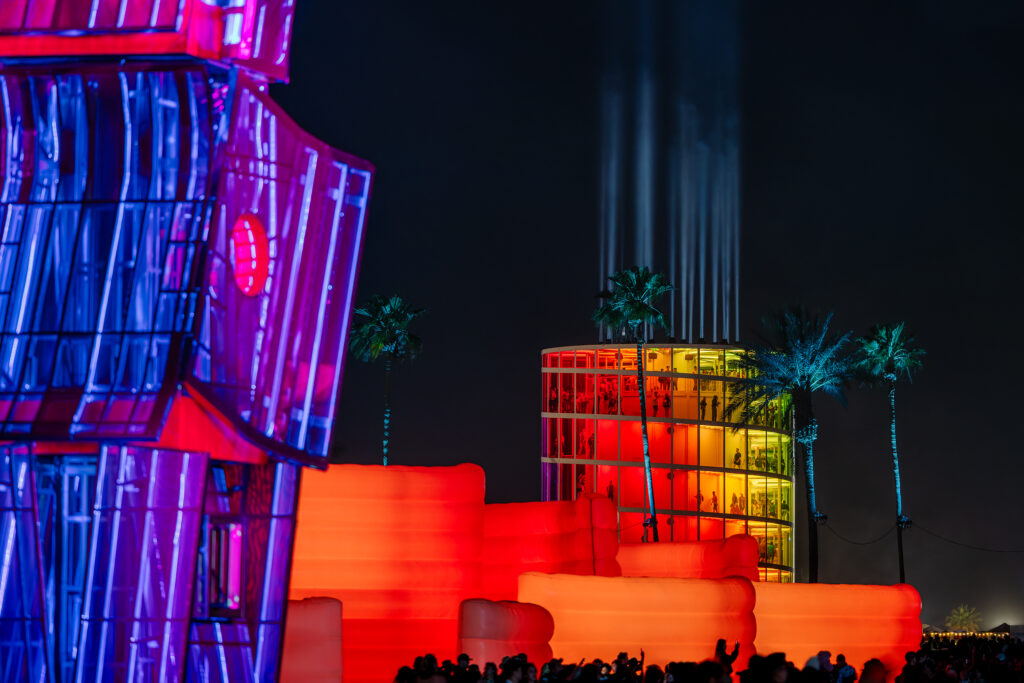
Rethinking and finessing the program in 2016 meant reducing the number of artworks in favor of larger installations built nearby by skilled local crews over many months. As for the criteria, Lehrer looks for “a really distinct elevation and a silhouette that can read from thousands of feet away,” he says. “It should look good on camera. But first and foremost, work that’s super esoteric is not what this is about. To me, a work is successful if it can operate on multiple depths.” Spectra, the illuminated polychromatic transparent cylindrical tower by Newsubstance that’s a visual tease from both inside and outside its spiral ramp, became an instant hit upon its 2018 reveal. (Given that so much happens after dark, the illumination pros at Felix Lighting company are crucial to the art program’s efforts, too.)
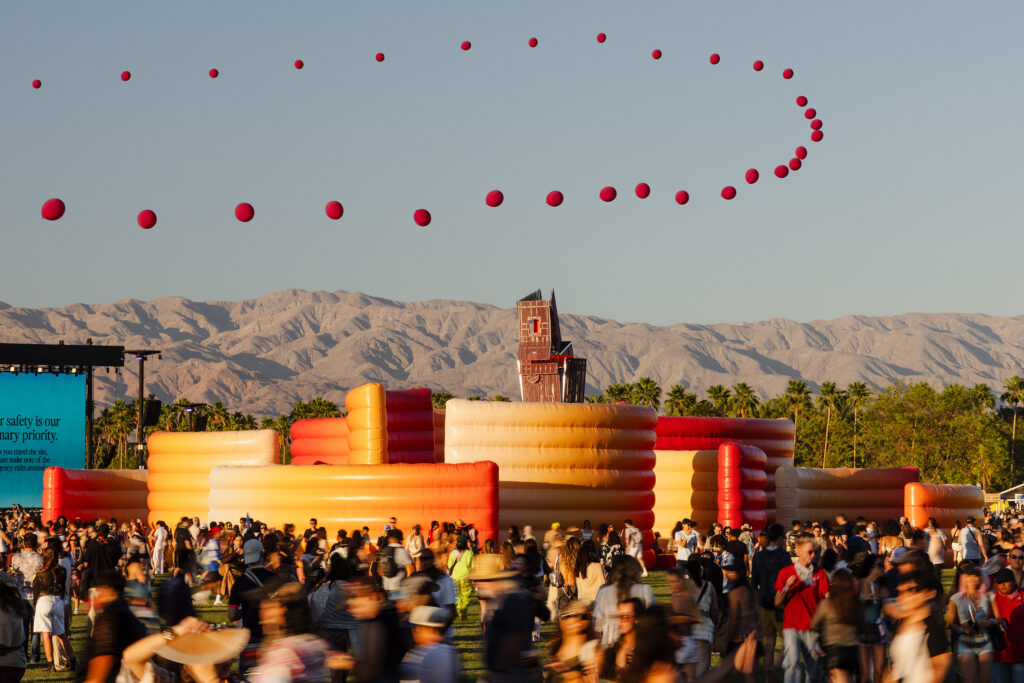
To the designers, the site is a nearly unparalleled chance to publicly experiment with physical size, materials, and technology. “It is so different than how I normally work. The scale is insane,” marvels Marcelis, the Dutch-born, New Zealand-raised artist and designer who, from her Rotterdam studio, has collaborated with brands ranging from IKEA to Celine to Calico wallpaper. “I wanted to work with a process that would allow me to create a very big impact, but with the smallest amount of material as possible.” The result is akin to if Richard Serra were to ditch weathered steel for desert-hued inflatables so that “air is the main ingredient.” The voids shaped between the pieces produce a labyrinth for users to connect, relax, and discover. “I create so many pieces that go to someone’s home that I don’t know. With public space projects, you get direct feedback in real time,” Marcelis observes. When talking about seeing revelers experiencing Maze, her enthusiasm is palpable. “That’s so cool. Like, look at these people! They’re really enjoying it.”
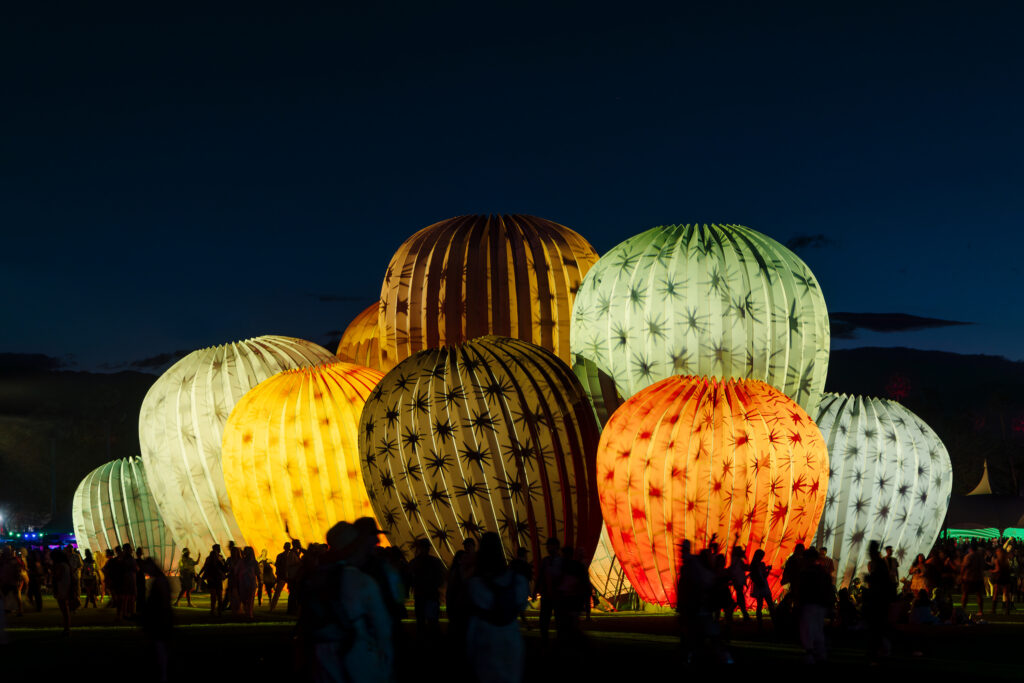
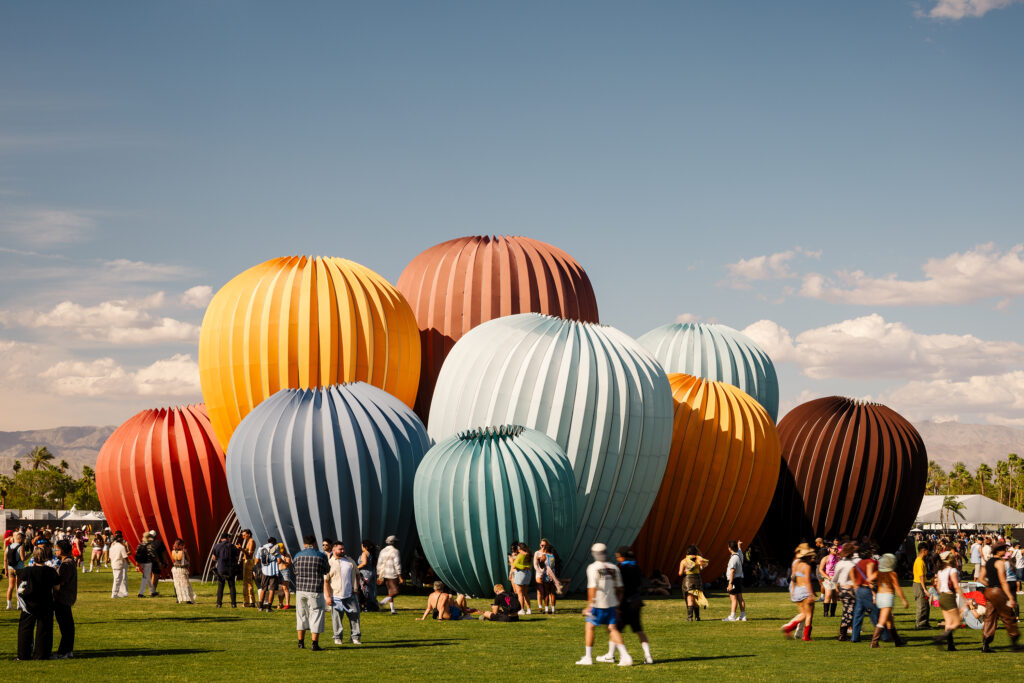
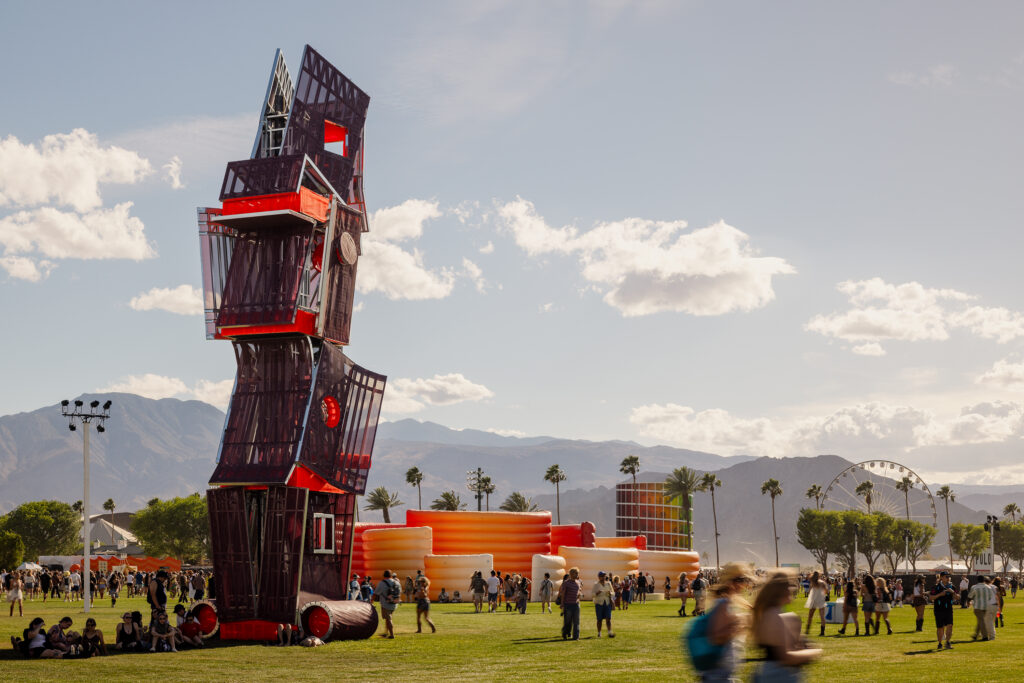
A brisk walk away stands Starry Eyes, Chatziparaskevas’s immersive cluster of 40-foot-tall steel structures that mimic the geometric form of golden barrel cactus. Inspiration from John Lautner’s Bob Hope house in Palm Springs appears in the shape of the occuli that cap each bulbous unit wrapped in an array of dusty desert colors. Come sunset, the volumes glow from within, and a series of motifs, including cactus needles and constellations, are projected onto the surfaces. The LADG’s jagged Visage Brut modular tower (fabricated in collaboration with Stud-IO Construction) opts for a vertical, gravity-defying effect. The team’s environmentally conscious approach is a less visible yet no less important element. “We set out to generate as little waste as possible. The piece is largely reusable,” says Ben Freyinger, co-principal of the LADG, noting that the larger steel components can be repurposed and other metal parts are recyclable.
Rather than functioning as ephemera, multiple Coachella commissions have been relocated to permanent locations around the region. Newly installed works include Pritzker Prize winner Francis Kéré’s Sarbalé ke at Dr. Carreon Park in Indio and HANNAH’s Monarchs: A House in Three Parts at Lake Cahuilla Veterans Regional Park. Taffy, created last year by Stephanie Lin, is in the process of moving to its new home in Palm Desert Park. This initiative reinforces Public Art Company’s goals for the Coachella art program, which values long-term benefits over immediate gratification. “It’s an opportunity to create work that can open up more people to what art, design, and architecture can be in their lives,” Lehrer says.