
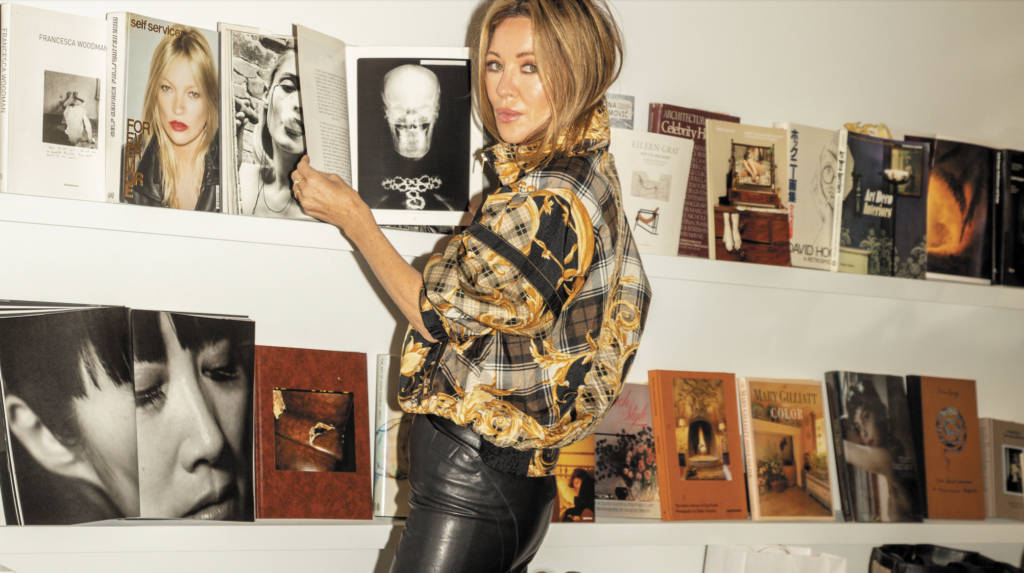
15 Minutes with Tiffany Howell
Author:Lindsey ShookSome interior designers understand that creating a space—a home, a feeling—is about far more than fabrics and furniture. It’s about telling a story. Tiffany Howell, the L.A.-based designer and creative director behind Night Palm, curates each project with a rhythm and rhyme that unfolds like poetry. Here, we share our conversation with her about her inspirations, her approach to design and her enduring love for California.
Where did the name Night Palm emerge from? “Night Palm” was originally the title of a poem I wrote years ago about living in Silver Lake. I lived on a street lined with palm trees that felt like the L.A. of my imagination—the version I had always romanticized. The poem became a love letter to the city and to that chapter of my life. When I started my company, I kept coming back to the name because it already carried everything I loved: California, mystery, nostalgia, beauty and a sense of place. It never felt like a company name. It felt like a feeling. So I kept it. And in many ways, that’s still how I approach everything I create.
Before becoming an interior designer, you worked as a poet, a music video director and a stylist. How did those experiences shape your aesthetic and approach to design? I think they taught me to pay attention. Poetry taught me restraint—that sometimes what’s left unsaid is the most important part. Directing music videos taught me how light, movement and composition can completely alter the mood of a scene. Styling taught me that a single object can shift the entire energy of an image. I’ve never viewed those pursuits as separate from design. They all revolve around observation and atmosphere. I just happen to use different mediums to explore the same questions.
What is it about living in L.A. that inspires your work? L.A. feels endlessly cinematic to me. There are very few places where a modernist masterpiece, a strip mall, a hidden garden and a vintage neon sign can all coexist within the same block. The city embraces contradiction, which I find incredibly inspiring. It’s also a city built on imagination. People come here to invent lives, ideas, films, music, businesses. There is a creative optimism woven into L.A. that continues to inspire me after all these years.
Can you walk us through how you and Laura Harrier co-designed the recent collection with Crate & Barrel? Laura and I became friends long before we designed the collection together. Over the years we collaborated on multiple home projects and discovered a shared love of film, fashion, travel and interiors. When the opportunity to create a collection together came along, it felt incredibly natural. The process began with conversations and references rather than furniture.
How does your approach to interior design differ from product design? An interior unfolds over time. A product has to communicate almost immediately. When I’m designing a home, I’m thinking about how someone lives within a space—the rituals, the light, the seasons, the passage of a day. Product design requires a different kind of discipline. Every detail has to work harder because the scale is smaller. In some ways, product design feels closer to writing poetry. You’re trying to express a complete idea with fewer words.
Favorite hotel in California for a quick getaway? La Playa Hotel in Carmel. I love its history as a gathering place for artists, poets and beatniks, but what keeps me coming back is the atmosphere today. It feels like a small European seaside hotel tucked inside a California coastal town. The cocktails are fantastic, the music drifts through analog speakers and the entire place has a sense of romance that’s increasingly hard to find.
If you could design a home for anyone (dead or alive), who would it be? David Bowie. I’ve always been drawn to artists who continually reinvent themselves, and no one did that more beautifully than Bowie. He understood that creativity isn’t a destination—it’s an evolution. Designing a home for him wouldn’t be about creating a backdrop. It would be about creating a world worthy of his imagination.
If you weren’t a designer, what would you be? This is a trick question because I’ve never really thought of myself as only a designer. But if I had an entirely different life, I’d probably be running an animal rescue somewhere in the countryside. I’d spend my mornings caring for miniature donkeys and my afternoons reading them poetry. Honestly, that still sounds like a pretty good life.